Keep Driving does something really difficult: it makes you nostalgic for something you’ve never experienced. A perfect road trip exists in the collective imagination, windows down, music, friends waiting at your destination, but the real experience is more complicated. Planning is tedious. The kilometers blur together. The unexpected happens. Keep Driving captures all of this and somehow turns it into something compelling, meditative, and sometimes hilarious. A guitar case takes up half the space in your trunk. A hitchhiker has a gambling problem. You chain smoke cigarettes to calm down a child who pees in your passenger seat. This shouldn’t work like a game. It works wonderfully.

The central loop
Keep Driving works like a roguelike road trip. You have all summer to catch the Way Out East music festival across the country. You have a car, cash and a destination. What you don’t have is a fixed route. Each time you arrive at a stop, you choose your next path based on what you need: fuel, money, food, rest, repairs. Some routes are shorter but riskier. Others are longer but lead to better stops. It’s a simple decision-making framework that creates constant tension. Should I take the fast lane and hope for the best, or do I play it safe?
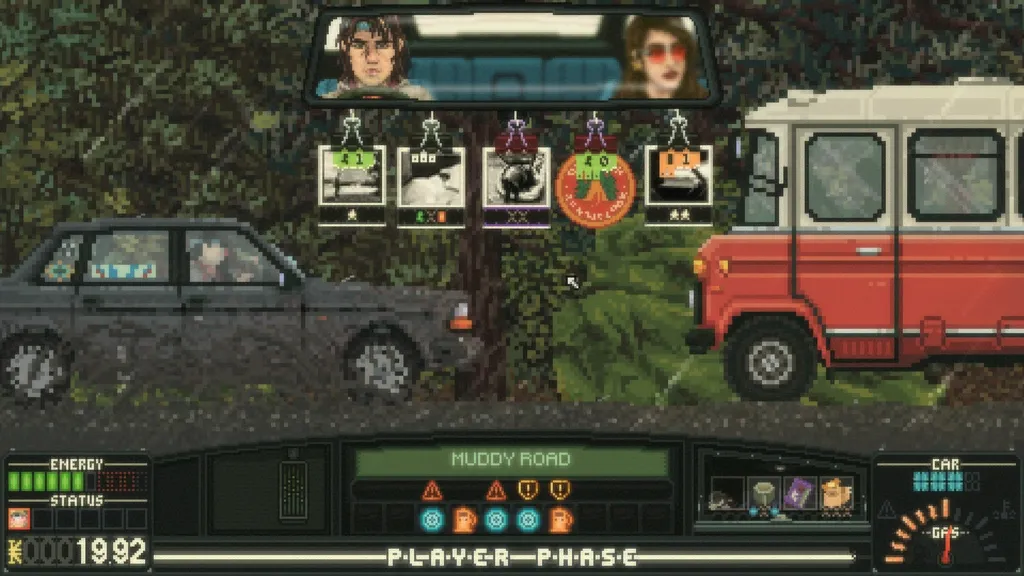
As you drive, obstacles appear. Traffic jams. Tractors broken down. Bikers. Speed cameras. These are not fights in the traditional sense. These are resource management puzzles. You use items from your glove compartment, skills learned from hitchhikers, or special abilities to counter them. Use the wrong approach and you’ll lose fuel, money, energy, or the durability of your car. Fail to deal with threats before your turn ends and the damage piles up. It’s a system that respects your planning without punishing experimentation.
The heart: hitchhikers
Where Keep Driving really sings is with the hitchhikers. Pick a musician and their guitar case claims half your trunk. Take a convict and you’ll drive faster, encountering fewer obstacles but more police. A free spirit brings party atmospheres and chaos. Each hitchhiker has skills you can use during encounters, but also drawbacks you must deal with. The Convict makes you fast. The hurricane forces you to commit occasional shoplifting. It’s not just about mechanical compromises. They are characters.
As you drive with them, conversations emerge. Brief snippets of dialogue flesh out their stories. A hitchhiker talks about his past. You learn the reasons why they are on the road. Then they ask for help to achieve their own goals. Complete their quest and they leave. I found myself really sad to see the characters leave, surprised by how endearing four lines of dialogue could create.
The real magic is that you constantly choose your own adventure. Halfway there, your grandmother sends you a letter asking you to visit her in the hospital. Help her and you will get land as an inheritance, opening up a new destination. Ignore it and continue driving to the festival. These are not branching dialog trees. These are the moments at the crossroads where your choice really matters.

Atmosphere and aesthetics
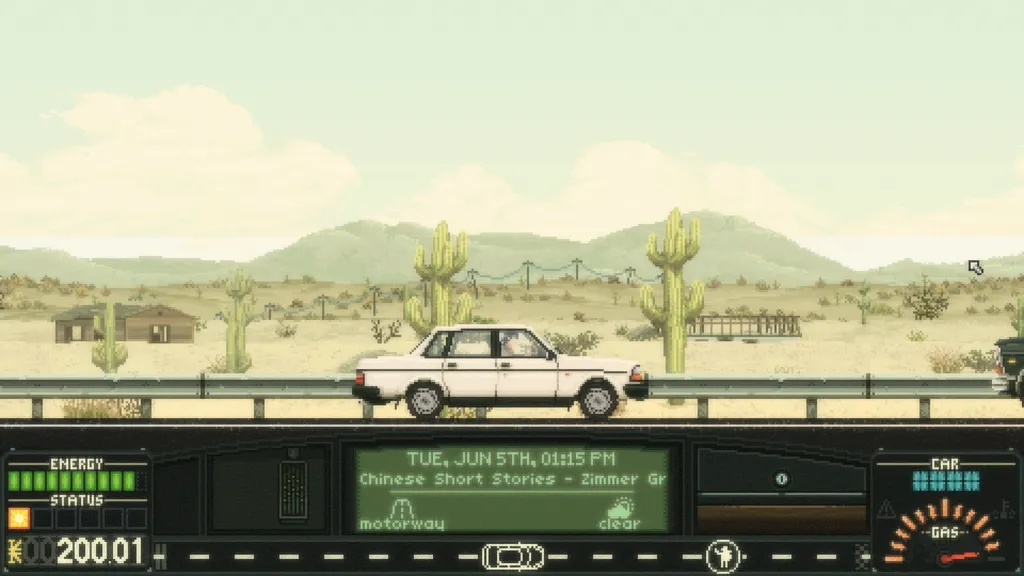
Pixel art is where Keep Driving makes its strongest statement. Parallax-scrolling backgrounds show cities giving way to forests, storm clouds, and an open highway. A Jesus figurine moves as you drive. Your glove box comes alive when opened. The dashboard is at the bottom of the screen and shows everything you need: energy, hunger, fuel, car health, money. It all looks like a real car interior, carefully observed and lovingly rendered.
The soundtrack might be the biggest design decision. Swedish indie rock, shoegaze, dreampop, that particular Gothenburg sound. The developers collaborated with groups like Westkust and Crystal Boys to create a curated collection. You unlock new CDs as you travel, expanding your musical options. Most players hit “randomly” and get caught up in the game. I started listening to the soundtrack separately and it became inseparable from the experience. This is how you create a licensed soundtrack: not as an afterthought, but as the emotional backbone of the entire game.

Rough edges
Continuing to drive is not frictionless. Inventory management can seem complicated. Finding room for new items when your trunk is full creates a constant tetris-like frustration. Some user interface interactions do not always behave as expected. The placement of objects sometimes presents problems. Randomizing procedurally generated stops means you’ll sometimes spend more time than necessary searching for a specific upgrade or location.
Hitchhikers suffer penalties without always feeling balanced with their bonuses. Taking several passengers means absorbing all their inconveniences, which can pile up uncomfortably. These are minor issues in an otherwise focused experience, but they are occasionally irritating.
Multiple endings
Keep Driving teases nine different endings. The Way Out Festival is one of them. You could become a wage slave. Join a car race. Inherit your grandmother’s land. Get arrested. Each ending comes from different choices and encounters. The game never explicitly tells you how to trigger them. You discover them by playing differently, by making new choices, by pursuing different objectives. It’s replayability designed around curiosity rather than grinding.

It’s worth a try
Keep Driving is a small miracle. Two Swedish developers have created something that captures the contradictory beauty of a road trip: the freedom and constraint, the boredom and adventure, the strangers who briefly become important and then disappear from your life. It’s a game about the journey being more important than the destination, which is a cliché until you’re truly emotionally invested in whether your hitchhiker will make it home.
The pixel art is beautiful. The soundtrack is phenomenal. The writing is minimalist but effective. The systems engage naturally. Yes, there are rough edges. Yes, the inventory system can be frustrating. But Keep Driving understands something fundamental about road trips that most games lack: it’s about the accumulation of small moments, conversations with strangers, and the strange melancholy of knowing that nothing lasts forever.
This is a game you’ll recommend to people even if they look confused when you describe it. But those who play it will understand.
Frequently Asked Questions
On which platforms is Keep Driving available?
Keep Driving is available on PC via Steam and recently launched on consoles including Xbox. The game supports multiple platforms allowing players to experience the road trip on their preferred system.
How long does it take to complete Keep Driving?
A single game of Keep Driving typically takes 2-3 hours if you are driving directly to your destination. However, with multiple endings, side quests, and different routes to explore, the game can provide over 10 hours of content over multiple playthroughs.
How many endings does Keep Driving have?
Keep Driving features nine different endings, including the main festival destination and alternative outcomes such as becoming a wage slave, joining a car race, inheriting land, or risking arrest. Each ending comes from different player choices and decisions throughout the journey.
Who developed Keep Driving?
Keep Driving was developed by YCJY Games, a small Swedish studio based in Gothenburg consisting of two lead developers: Josef Martinovsky (art, animation and design) and Christopher Andreasson (programming and design).
How is the soundtrack?
The soundtrack features Swedish indie rock with shoegaze and dreampop influences, featuring local Gothenburg bands including Westkust and Crystal Boys. Players unlock new CDs throughout their journey, expanding the music selection. The soundtrack is available separately on streaming platforms.
Can you pick up hitchhikers in Keep Driving?
Yes, hitchhikers are the heart of the experience. Each passenger brings unique abilities and drawbacks, and conversations with them reveal their personal stories. Completing their side quests may cause them to leave your vehicle, creating an emotional investment despite minimal dialogue.
How does the inventory management system work?
Keep Driving uses a Resident Evil 4-style inventory system where your chosen vehicle determines trunk space. Inventory management is crucial because items take up different amounts of space. Players must balance carrying supplies (food, fuel, repairs) with passengers’ personal belongings like musical instruments or luggage.
What happens if I run out of gas or money?
If you run out of gas and have money, you can walk back to a gas station. Running out of money or having a car break down requires calling your parents for help. Their answer depends on your relationship status established at the beginning, so it is recommended to choose a good relationship with parents.